Marc Gosselin, MD, Medical Director, SIRIUSMEDx
For years, there was hesitation about actively warming a victim suffering from moderate or severe hypothermia. It was even taught to avoid external heat "so as not to cause an afterdrop effect" — the paradoxical cooling caused by cold blood returning to the core.
It made sense at the time... but that's not what science tells us today.
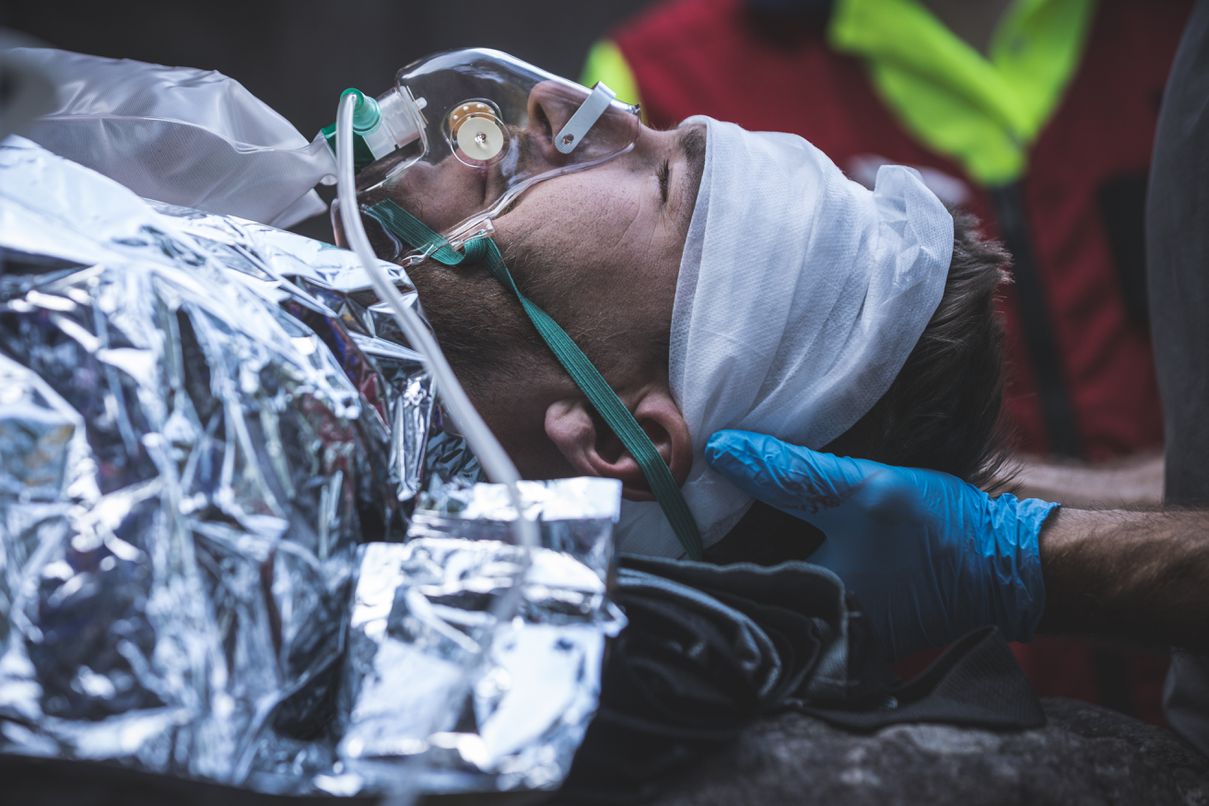
In our SIRIUSMEDx field manual, we already recommend active external warming for moderate (and sometimes severe) hypothermia, emphasizing full wrapping—the famous burrito or hypothermic wrap. This change raised some excellent questions, which led to the writing of this article.
It was time to set the record straight—with modern data, guidelines (WMS, ICAR, ERC), and the remarkable work of researchers such as Dr. Doug Brown (UBC) and Jørgen Melau (Norway).
*Glossary of acronyms and short bio of authors cited at the end of the text.
Why was external warming believed to be dangerous?
For a long time, the conventional theory held that warming the skin of a hypothermic victim could:
- cause cold blood to flow to the heart,
- exacerbate the afterdrop effect,
- trigger arrhythmias.
This design was based on old models, not on real physiological data—very few serious studies existed.
Then came the work of Dr. Doug Brown and other researchers, who summed up the reality in a phrase that has become indispensable:
"The danger is not the heat. The danger is movement."
— Doug Brown, UBC Emergency Medicine
What modern research shows
The work of Jørgen Melau, one of the most prolific researchers in the field, has helped us understand what really happens in a cooled body.
Based on studies conducted on swimmers in cold water, volunteers in controlled hypothermia, and detailed physiological analyses, Melau demonstrates the following:
Afterdrop is mainly caused by the mobilization of cold blood from the limbs—not by heat applied to the trunk.
— Jørgen Melau, University of Southeast Norway
These data, confirmed by Paal, Brugger, and Brown, are now incorporated into the ICAR/UIAA guidelines.
Today, all major organizations agree:
In moderate to severe hypothermia:
👉 Actively warming the torso is recommended and safe.
👉 The old term "danger from external heat" is outdated.
The actual effect of external warming in the prehospital setting
We must be clear—and honest:
External warming has a real but modest effect.
Prehospital studies show an increase in core temperature of approximately 0.5 to 1.5°C/h under the best conditions:
- excellent insulation,
- vapor barrier,
- application of heat to the trunk,
- absence of movement,
- heating packs or continuous heat.
It's not spectacular... but it's enough to stabilize, slow down cooling, and above all, save time.
As Dr. Brown says:
« Active external rewarming doesn’t save the patient — it buys you time to get them to the treatment that will. »
And this sentence perfectly sums up the prehospital role.
🔥 External warming methods: what really works
To teach effectively, you need to be clear about what works, how, and within what limits.
1️⃣ Insulation: the most important step
Before adding heat, heat loss must be prevented.
- Remove wet clothing as quickly as possible.
- Add a vapor barrier,
- Pack in insulating multilayers,
- Eliminate any drafts,
- Limit handling.
👉 Without insulation, no active heating is effective.
2️⃣ Heat the trunk (and only the trunk)
All modern guidelines affirm this:
❌ Do not apply direct heat to the extremities.
✔ Warm up your chest, back, and armpits.
Because that is where the vital organs (heart and lungs) are located, and warming the limbs may cause cold blood to be drawn away from them.
3️⃣ Effective warm-up methods in the field
🔶 Hot water packs or hot water bottles
- A low-tech but still effective method
- To be placed on the chest, back, or armpits
- Always insulate to prevent burns.
🔶 Chemical heating packs
(Hothands™, Grabber™, Heat Factory™)
- Very accessible
- Long duration
- Perfect in a hypothermic wrap (burrito)
🔶 Ready-Heat™ Chemical Heating Blankets
- Used in SAR, ambulances, helicopter evacuations
- Gentle, continuous, and safe heating
🔶 Electric heated blankets (batteries)
- Highly effective in ambulances and helicopter transport (HEMS)
- Limited by range and available equipment
🔶 Forced hot air systems
- Portable version of Bair Hugger™
- EffEffective in enclosed spaces (ambulances, mobile clinics)icaces en milieu clos (ambulance, clinique mobile)
4️⃣ Complementary methods (“minimally invasive warming”)
✔ Lukewarm IV fluids (38–42°C): if IV available.
✔ Warm/humidified oxygen: low benefit but comfortable
5️⃣ What doesn't work
❌ Warm up limbs
❌ Get the person to walk or activate them
❌ Massage, rub, and "wake up" the victim.
❌ Handle roughly
👉 Risks: afterdrop, arrhythmias, instability.
🏥 The real treatment takes place in the hospital.
For severe hypothermia, WMS, ICAR, and ERC are unequivocal:
✔ Severe hypothermia = rapid transport to a center capable of advanced internal rewarming.
✔ Severe unstable hypothermia or cardiac arrest = priority ECMO/ECLS center.
ECMO: a revolution in the survival of severe hypothermia
What is ECMO?
It is a device that circulates blood outside the body, warms it, and oxygenates it while the heart and lungs recover.
Available only in certain tertiary centers, ECMO has transformed the prognosis for severe hypothermia, especially in Europe, where distances are shorter and helicopter transport is well developed.
Impressive physiological effects:
- Warming up to 6–9 °C/h
- Full cardiac and respiratory support
- Recovery possible at temperatures < 20°C
- Possible survival after prolonged cardiac arrest
As Paal writes:
« ECMO has changed the limits of survivability in severe hypothermia. »
And Dr. Brown sums it up clearly:
« If they’re severely hypothermic and have a beating heart, get them to ECMO. If they’re in arrest, get them to ECMO even faster. »
🎒 What we need to teach our SIRIUSMEDx students
✔ Patient moderately hypothermic and confused
- Active core warm-up
- No mobilization
- No heating of extremities
✔ Patient with severe hypothermia
- Same approach, even gentler
- Priority: transport to hospital and possibly to an ECMO center
✔ Key points to remember
- External warming = modest but significant effect
- Safe at the trunk
- Essential for stabilization
- Never enough to warm up to safe level
🔚 Conclusion
Modern data has transformed our understanding of external warming into moderate to severe hypothermia:
- External warming is not dangerous.
- He stabilizes the victim,
- It saves time,
- But the actual treatment is done at the hospital,
- And in severe cases, ECMO is revolutionary.
Let us never forget that medical science is constantly evolving, and that our teaching must keep pace with the latest data. What was contraindicated yesterday may become the norm today—and vice versa.
It can be unsettling at times... but that's also the beauty of our profession: remaining students for life, so that we can better pass on our knowledge.
Thank you to the entire SIRIUSMEDx community for keeping this curiosity alive, dynamic, and essential. It is thanks to you that we continue to offer training rooted in science and faithful to the reality of the field.
Short glossary of acronyms
WMS — Wilderness Medical Society: An international organization that publishes the standard guidelines for medicine in remote areas.
ICAR — International Commission for Alpine Rescue: International medical commission specializing in mountain rescue (UIAA/ICAR MedCom).
ERC — European Resuscitation Council: European organization responsible for resuscitation guidelines, including the section on "special situations" such as hypothermia.
ECMO — Extracorporeal Membrane Oxygenation: An advanced resuscitation device that temporarily takes over the functions of the heart and lungs by oxygenating and warming the blood outside the body.
ECLS — Extracorporeal Life Support: Term encompassing all forms of extracorporeal circulatory support, including ECMO.
SAR — Search and Rescue: Land, sea, or air search and rescue services.
HEMS — Helicopter Emergency Medical Services: Emergency medical services provided by helicopter (air evacuations).
AJEM — American Journal of Emergency Medicine: Scientific journal in which several studies on prehospital hypothermia have been published.
IV — Intravenous: Administration of a liquid or medication directly into a vein.
UIAA — International Union of Alpine Associations: International organization associated with ICAR for recommendations in alpine environments.
Bio of the authors cited
Dr Doug Brown, MD
Emergency physician at the University of British Columbia (UBC), renowned clinician and educator in cold physiology and hypothermia management. He is the author of several educational guides widely used in North America, including Accidental Hypothermia Simplified, and has helped modernize prehospital practices by clarifying the indications for active external rewarming.
Jørgen Melau, MSc, PhD(c)
Norwegian researcher specializing in the physiology of cold water immersion, afterdrop, and cardiovascular responses to hypothermia. Affiliated with the University of South-Eastern Norway (USN), he collaborates with ICAR/UIAA and several European research teams. His experimental work has profoundly influenced the evolution of international recommendations on prehospital management of hypothermia.
Dr Hermann Brugger, MD
Mountain doctor and researcher based at the EURAC Research Center (Italy), specializing in hypothermia, frostbite, and alpine medicine. He is one of the scientific leaders of the ICAR MedCom group and a major author of international guidelines on hypothermia and resuscitation in harsh environments.
Dr Peter Paal, MD, PhD
Anesthesiologist, intensivist, and world expert in accidental hypothermia. Professor at the University of Salzburg and active member of ICAR MedCom, he has published numerous key studies on extracorporeal membrane oxygenation (ECMO) and modern advanced rewarming strategies in severe hypothermia. His work has greatly contributed to redefining current standards.
Dr Andrew Haverkamp, MD
Emergency physician who published a major systematic review (AJEM, 2018) on the prehospital management of hypothermia. His work highlighted the modest but significant effectiveness of external warming and the crucial importance of insulation and prevention of heat loss.
European Resuscitation Council (ERC) — Special Circumstances Group
Scientific committee responsible for European resuscitation recommendations for "special situations," including severe hypothermia, immersion, and burial. Their 2021–2024 guidelines are now used as a global reference for harmonizing prehospital and hospital practices.
Wilderness Medical Society (WMS) — Practice Guidelines Committee
Groupe d’experts internationaux en médeGroup of international experts in remote area medicine. They regularly publish Clinical Practice Guidelines used by instructors, SAR organizations, military circles, and expedition teams. The 2019–2024 versions have redefined modern hypothermia management in wilderness settings.cine de régions isolées. Ils publient régulièrement les Clinical Practice Guidelines utilisées par les instructeurs, organisations SAR, milieux militaires et équipes expéditionnaires. Les versions 2019–2024 ont redéfini la prise en charge moderne de l’hypothermie en contexte sauvage.