On October 22, 2025, the American Heart Association (AHA) released the most significant update to its guidelines since 2020.
These changes, which have also been approved by the International Liaison Committee on Resuscitation (ILCOR), have a direct impact on our teaching practices, both for basic training and advanced training in remote areas.
At SIRIUSMEDx, we reviewed these new recommendations from an instructor's perspective: what do we need to communicate differently? What actions, messages, or tools do we need to update?
🔗 A unified chain of survival: a simpler message to teach
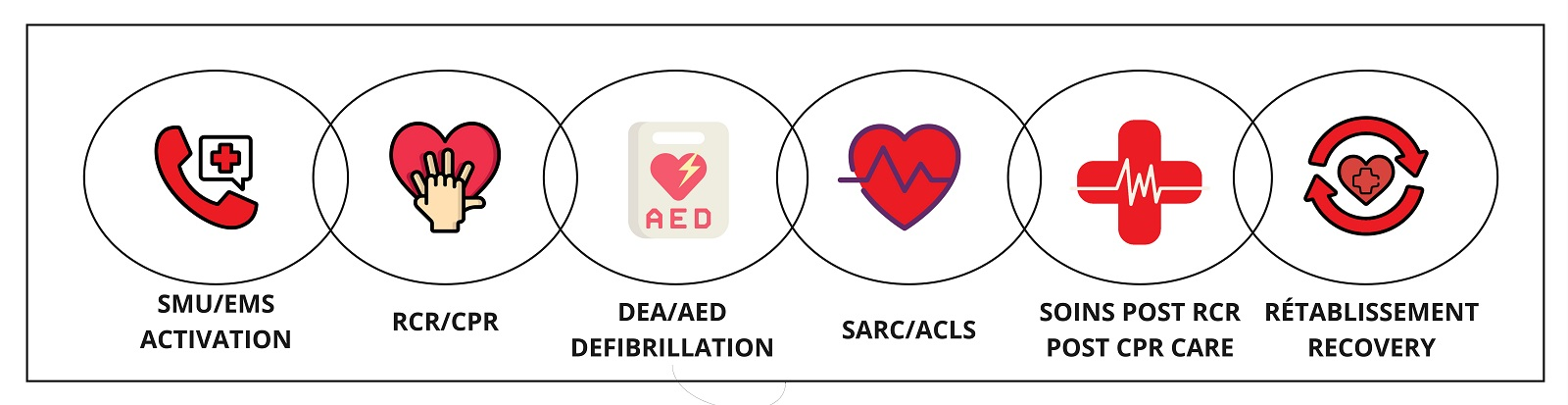
The AHA now introduces a single chain of survival, applicable to adults, children, and both in-hospital and out-of-hospital settings.
This simplification clarifies the sequence for learners and reinforces the message:
"Resuscitation is above all a human chain where every link counts."
Instructors are encouraged to incorporate this unique visual into their materials and to emphasize prevention, rapid recognition, and post-event debriefing, which are now included as official steps.
🧒 Training from age 12: the beginning of CPR culture
The AHA confirms that young people aged 12 and older can learn and perform CPR effectively.
For us, this opens the door to community and school activities:
- youth workshops in partnership with schools or camps;
- involvement of families in first aid training;
- Inclusion of concrete examples promoting confidence and recognition of cardiac arrest.
The message: the earlier we train, the more lives we save.
📲 Real-time technology and feedback
The new guidelines emphasize the importance of feedback tools:
metronomes, depth sensors, connected mannequins, and even mobile applications.
These tools help learners achieve the recommended compression quality (100–120/min, 5–6 cm).
🎓 In practice: each practical session should include at least one objective feedback mechanism.
This transforms training into a measurable, engaging, and more effective experience.
💊 New recommendations on opioid overdoses
The AHA introduces an integrated algorithm for overdose management and recommends public access to naloxone, similar to AEDs.
SIRIUSMEDx instructors can now:
- address this topic in the sections "medical emergency" or "primary assessment,"
- explain when and how to administer naloxone (nasal spray),
- highlight the parallel between "public DEA" and "public naloxone."
This is an important development for our courses in urban or community settings.
💬 Systematic debriefing: learning after every action
The AHA emphasizes immediate debriefing (hot debriefing) followed by delayed debriefing (cold debriefing) as an integral part of the resuscitation process.
For trainers, this confirms the value of our reflective methods:
- encourage participants to verbalize what they felt;
- emphasize team communication and mental load;
- Conclude each workshop with a brief structured debriefing.
Debriefing is becoming a skill to be taught rather than a mere supplement.
🧠 Focus on quality, not novelty
The technical parameters (frequency, depth, 30:2 ratio) remain unchanged, but the philosophy is evolving:
Fewer new products, higher quality.
The AHA and ILCOR encourage a culture of continuous improvement: evaluation of practices, analysis of simulation data, and long-term maintenance of skills.
For us, this means:
- plan more frequent practical reviews;
- create realistic and contextualized situations (terrain, weather, stress, isolation);
- improve consistency in messaging between instructors.
👩🏫 Summary for our trainers
| Theme | Key message for teaching |
|---|---|
| Chain of survival | One for all contexts – easier to teach |
| Minimum age for training | 12 years old: opening up to the community and young people |
| Use of feedback technology | Use connected tools to improve performance |
| Public naloxone | Linking to DEAs: a new first aid reflex |
| Debriefing | Hot and cold debriefings are key components of effective learning |
| General philosophy | Less new technology, more quality, consistency, and a culture of practice |
🔍 Pour en savoir plus
Official documents:
- Highlights of the 2025 AHA Guidelines (October 22, 2025)
- ILCOR CoSTR 2025 – Education and Care Systems
- Updated algorithms: BLS, ALS, PALS, NLS available at www.heart.org and in the SIRIUSMEDx instructor area.
💡 Key takeaway
These updates do not disrupt our practices; they confirm and reinforce them.
Our role as instructors becomes even more central: teaching techniques, but above all, a culture of quality and trust.