By Marc Gosselin, M.D., Medical Director, SIRIUSMEDx
THE ESSENTIALS IN TWELVE POINTS
1. Under stress, your working memory becomes saturated. You keep what you know well, but you lose the mental space to process what's happening.
2. The responder who is rarely called on is perfectly capable of intervening. What they lack is experience, and a lack of experience is offset by structure.
3. High-performing emergency teams do everything they can to avoid relying on memory. Like pilots, they go through their checklist even when everything is going well, and no one takes it as a sign of incompetence.
4. A well-learned mnemonic, such as XABCDE or SAMPLE, holds up under stress. But it only reminds you of the questions, never the answers.
5. Trois compartiments dans le coffre à outils, et aucun ne remplace les autres : quelques mnémoniques dans la tête, la fiche Système d'évaluation du patient (SEP) et un crayon dans la poche ou la trousse de premiers soins, et une application hors ligne dans le téléphone.
6. Every piece of information you write down is one less thing to keep in your head. The form frees up your memory instead of loading it.
7. When care lasts for hours, the trend matters more than any single reading. Without a chronological series, the change will pass you by.
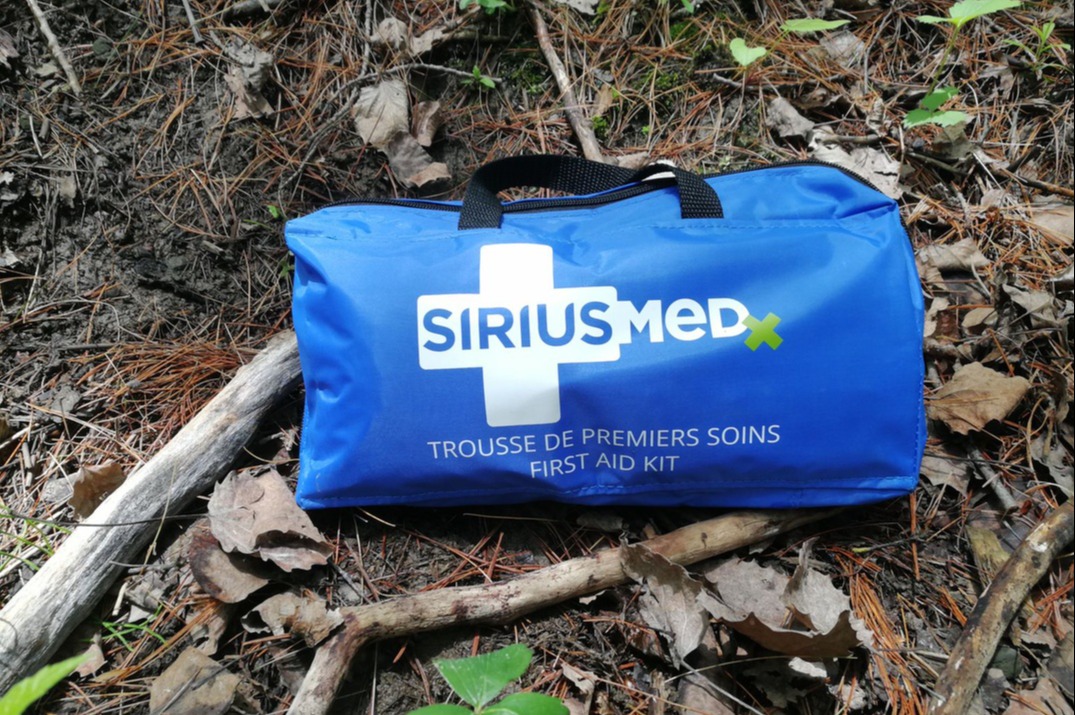
8. A kit organized by problem rather than by type of item, in a fixed order, with the form and a pencil on top.
9. Organize the space before providing care: a fixed position beside the patient, a perimeter that keeps onlookers back, and a supply area that never moves. Every person who speaks and every item you have to search for costs you attention.
10. You're rarely alone, but more often than not you'll be the only one trained in first aid. Delegate everything that isn't clinical, following the rule of one person, one task, one instruction you can verify. The scribe who writes while you dictate gives you your working memory back.
11. Before the event, the ego always finds a reason to do without the form. During the call, it isn't there to help you. Pulling out the patient assessment form isn't an admission of incompetence, it's your best ally when the pressure mounts.
12. A tool you've never practised with won't be used on the day it matters. Fill out the form in every simulation, and under different conditions: in the cold, in the rain, by headlamp.
What Happens in the First Few Minutes
Stress doesn't erase what you know. It erases the mental space you need to use it.
You're on a trail, a three-hour walk from the parking lot. Someone falls right in front of you and doesn't get back up.
What happens in your mind at that moment is fairly predictable, and that's precisely why you can prepare for it. You get a rush of adrenaline, which shows up as an increased heart rate, tunnel vision and impaired hearing. Your working memory shrinks as well. Working memory is that limited mental space where you handle incoming information. Cognitive load theory describes it as a finite resource, incapable of holding more than a small amount of information at a time. This limit applies only to new information, though, the kind coming in through your senses. What you've learned and consolidated over the years is processed differently by the brain.
In practice, this means that under stress you keep what you know well, but your ability to process what's happening becomes saturated. And in an emergency, everything arrives at once: the patient, the group getting agitated, the weather turning, the phone with no signal, your own fear. The quality of your response depends in large part on how you manage that load.
The Unique Situation of the Occasional First Responder
What the occasional responder lacks is not the ability to intervene. It's experience, and a lack of experience is offset by structure.
Over the years, paramedics, emergency physicians and trauma nurses develop a form of rapid, almost automatic recognition, built on thousands of repetitions. They identify clinical patterns before they even analyze them. This way of thinking is economical in mental resources, and it comes from repeated exposure.
That's exactly what the responder in remote areas rarely has. The guide, the remote-area worker, the patroller or the parent on an expedition may well hold a 20, 40 or 80-hour remote first aid certification, but they may have earned it two years ago. Since then, how many times have they used it? Often not once.
The low frequency of serious situations is not a problem unique to first aid. It's a challenge for many organizations, particularly in settings where safety is a priority. In the operating room, in aviation, in nuclear power plants, the assumption is that a responder may not face a crisis for years, or ever. The answer in those settings has not been to ask people to keep every emergency procedure in their heads. They develop tools instead, and they put protocols and procedures in place. What the occasional responder lacks is not the ability to intervene, it's experience, and a lack of experience is offset by structure.
What Emergency Teams Do
The most experienced teams are the ones that rely least on their memory.
The most experienced teams are the ones that rely least on memory.
Written checklists have become standard practice. The emergency manuals developed at Stanford and the crisis checklists from Ariadne Labs are now used in thousands of operating rooms. These aren't crutches for beginners, they're tools designed by experts for experts. In a randomized simulator trial published in the New England Journal of Medicine, the use of a checklist cut failures to perform critical steps by roughly 75%. An Australian trial involving emergency department resuscitation scenarios found a 54% overall reduction in errors with a protocol manual, and 97% of participants said they would want one available during a real crisis. The gap isn't marginal. It's the difference between a sound intervention and one where something important gets missed.
Many teams also designate a reader, someone whose job is to read the checklist aloud while the others carry out the tasks. Having a reader is associated with better execution of key steps. The person leading doesn't read. They direct.
The pre-arrival briefing serves the same purpose. Before the patient arrives, the team takes a few seconds to establish who does what, what they're expecting and what the backup plan is. This work gets done while working memory is still available, which lightens the load in the high-pressure moment.
Closed-loop communication rounds out the picture. It's a tool every responder or field worker should master. "Marie, you take the vital signs," followed by "Got it, I'm taking the vital signs." It can seem heavy-handed, but in an emergency this redundancy eliminates an entire category of error: the task everyone assumed had been assigned to someone else. Add to that clarity of roles. You don't divide up tasks in the middle of a crisis; roles are assigned to each person, either just before acting in an unplanned situation, or well in advance in a controlled setting such as an emergency department.
These methods transfer easily to a non-medical context, to a group of hikers as much as to a work team. What they require is not a particular talent, it's leadership.
Mnemonics: Their Strengths and Limitations
A mnemonic reminds you of the questions. It doesn't retain the answers.
A mnemonic is a series of letters, which may or may not make sense in the context where they're used, that helps us remember a sequence or a set of actions to carry out. In first aid, examples include XABCDE, SAMPLE, AVPU, PERRLA and PQRST, to name only a few.
These acronyms are the oldest task-memorization tool in first aid training, and their staying power is easy to explain. A well-learned mnemonic settles into long-term memory, precisely where stress has the least hold. A first aider who has repeated XABCDE dozens of times will recall it under pressure, even after forgetting a great deal else.
Another advantage often credited to them is that they impose an order of priority. XABCDE doesn't just tell you what to check, it tells you in what order, and that order reflects what threatens life most. Knowing without thinking which action comes first prevents decision paralysis and greatly reduces stress.
Mnemonics do have their limits, though. Here are three.
First, a mnemonic only stores headings. SAMPLE reminds you to ask about history, but it doesn't hold the answer. You end up with six pieces of information to keep in your head while you carry on with the exam, which is exactly the load you were trying to avoid.
Second, a mnemonic erodes without practice. An acronym learned two years ago and never used comes back only in part: three letters out of five, or all five letters with no memory of what they stand for.
Third, the more of them you learn, the more you mix them up. Fifteen or so acronyms to keep straight, many of which sound alike and some of which circulate in different versions depending on the organization teaching them, and confusion becomes a risk in its own right.
The practical takeaway is simple: keep few mnemonics, keep the good ones, learn them properly, and use them for what they are, tools among others in a well-stocked box.
The Note Template
Every piece of information you write down is one less thing to keep in your head.
The PAS form (patient assessment system), or SOAP note, comes into its own here, and it's worth understanding why it works as well as it does.
A structured template first frees up your working memory. Every piece of information you write down is one less thing to retain. A heart rate recorded at 2:12 p.m. is safe on paper, and your memory becomes available again for what's happening now.
It then carries the sequence for you. The blank boxes are a memory aid in disguise. A scene assessment section with its six checkboxes reminds you of the six elements without your having to pull them from memory. The form carries the structure; you take care of the patient.
It also lets you step back, and gives you the perspective to catch trends that are sometimes invisible in the heat of the moment. A chronological series of vital signs shows a trajectory, and when care lasts for hours, that trajectory is worth more than any single reading. A pulse of 96 tells you nothing in particular. A pulse that has gone from 72 to 96 in forty minutes tells you a great deal. Without writing, you have no chance of catching that kind of drift. Good field notes also let you give a structured handoff to emergency services, and above all they leave a written record that is essential from a medicolegal standpoint.
Choosing the right level of form matters as much as its content. A full two-page form suits a 15-day expedition with a first responder in the group. It's poorly suited to a day trip where you're on your own. A one-page essential form, laminated and kept in the lid of the kit, will actually get filled out. The perfect form left in the car is worth nothing.
One detail that isn't a detail: use a pencil rather than a pen. A pen works neither in the rain nor in very cold weather. Tie it to the form.
Digital Applications and Tools
You can't stop severe bleeding with an iPhone.
A mnemonic fits in your head, a form fits in your pocket, and a mobile app holds an entire library, sometimes more.
Tools such as Paratus, built on the foundations of the EZResus app, illustrate what this generation of technology brings. These applications provide real-time support for protocols, procedures, decision algorithms and checklists. They work without an Internet connection and are designed to be used under pressure, with the number of taps kept to a minimum. The settings they target concern us directly: prehospital care, remote areas, expeditions, air medical transport.
Digital tools outperform paper on four counts. Calculations first, whether pediatric dosages or weight-based adjustments, exactly the kind of task where a brain under stress fails and a machine does not. Depth next, since an app holds what no form could ever carry. Targeted navigation, which reaches the right algorithm in a few taps rather than by flipping through a manual. Updates last, since protocols change while a card laminated in 2019 does not know it.
That doesn't make it perfect. The battery drains quickly in cold weather, which becomes a problem when the phone also serves as GPS, flashlight and a way to call for help, three functions that outrank consulting a protocol. The touchscreen becomes hard to use with wet gloves, in falling snow, with both hands already occupied. Availability depends on an active subscription, a system update and an accessible device, all points of failure a laminated card doesn't have. Sharing is harder too, since a form can be held by a second person while you work. In short, with digital tools you always need a plan B.
The architecture that works has three tiers rather than a choice between three options.
|
Tier |
Tool |
Role |
|
In your head |
Three or four solid mnemonics |
Get started without reaching for anything, manage the first two minutes |
|
In your pocket or first-aid kit |
Patient assessment System Form or SOAP note, practical guide, or field manual, and a pencil |
Structure, document, track the trend |
|
On your phone |
Offline Reference App |
Go deeper, calculate, verify when time allows |
The classic mistake is expecting the third tier to replace the first. Remember that you can't stop severe bleeding with an iPhone. The reverse holds just as well, since no one should be trying to hold in their head what can be read.
The Ego: The Obstacle No One Talks About
The ego resists before the event. It isn't there to help you during it.
There is one obstacle to using these tools that is neither technical nor pedagogical. It comes down to a phrase you hear often in training: "I don't need that." The reluctance is understandable, because pulling out a form in front of a group feels like an admission. Nor is it unusual. Resistance to cognitive aids has been documented even in operating rooms, among surgeons whose competence was never in question. It wasn't a knowledge problem, it was an image problem.
The ego speaks loudly in the comfort of the training room, when you're deciding what to bring and what to use. When the real situation arrives, it isn't there to help you. The responder who refused the form gains nothing in performance: they lose the means of verifying that they haven't forgotten anything, at the very moment when they're least able to notice it.
I was aboard an air ambulance helicopter on an urgent transport mission. We had just flown, without a single problem. The aircraft was warm, the crew knew each other, the patient was waiting. Before heading back out, the pilot ran his checklist again, as he always does, and found an oil leak. The transport was delayed, we had to reorganize, and plenty of people in that situation would not have rechecked. Their argument would have sounded solid: we had just flown, everything was fine, time mattered.
I will never know what would have happened had we left. When the check works, nothing happens, and you never measure what you avoided. What I do know is that the medical team went home that night.
The simplest way to defuse this resistance is not to let it make the decision in the moment. Pulling out the form shouldn't be a decision, it should be a habit set in advance, like putting on gloves. And no one around you will read it as a sign of incompetence. They'll read it as method.
Organizing the Equipment
Your hand should find the gloves quickly while your eyes stay on the patient.
Every second spent searching for an item in a kit is a second of mental capacity wasted, and worse, an interruption in your clinical reasoning.
Establish a fixed order and never change it. The system itself matters little, its consistency is what counts. Your hand should be able to reach the gloves without your eyes leaving the patient.
Group supplies by problem rather than by type of item. A bleeding pouch holding a tourniquet, pressure dressing, gauze and gloves serves you better than a dressing pouch and a glove pouch, because in the moment you think in problems, not in categories of equipment.
Color-code the pouches and label them on the outside to avoid having to open three of them before finding the right one. Place the PAS sheet and the pencil on top or inside the lid, since anything buried inside won't get used.
Finally, check the kit before you leave. Taking inventory while you're warm and unhurried is inventory you won't have to discover mid-call, and handling the equipment doubles as free mental rehearsal.
Organizing the Space
A responder who is shivering can't do the job properly.
The influence of physical organization on cognitive load is badly underestimated.
Choose your position and stay put. Place yourself on the same side of the patient every time: that consistency turns a decision into an automatism.
Set up a perimeter and move onlookers back. Every person who talks, films or asks a question consumes part of your attention, and pushing the circle out to three metres is a clinical act in its own right.
Designate a supply area. A tarp, a toque or an open bag, always in the same spot, where equipment arrives and where wrappers don't end up. Clutter around the patient turns into clutter in your head very quickly.
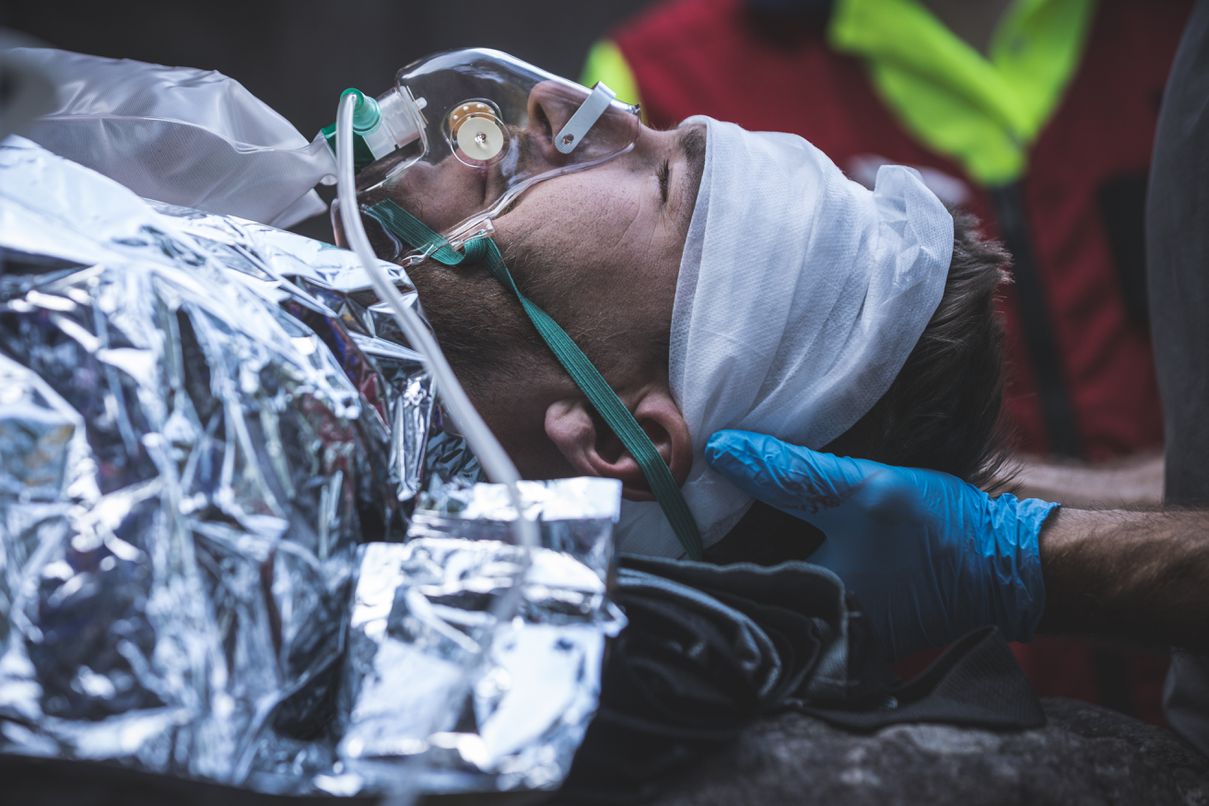
Treat the comfort of the patient and of the responders as a priority, not a luxury. A shelter, a sleeping pad under the patient, a thermal blanket: these measures improve the patient's condition, but they also stabilize the situation and give you back your ability to think. A responder who is shivering can't do the job properly.
Write the GPS coordinates on the form right at the start. You think you'll remember them. You won't.
Delegating
One person, one task, one instruction you can verify.
In remote settings, you are rarely alone. You are often the only trained person there, which is not the same thing.
Assign tasks by name, and make them concrete. "Help me" produces nothing. "Jean, take the orange bag, pull out the survival blanket and slide it under her" produces an action. The rule fits in a few words: one person, one task, one instruction you can verify. Have it confirmed back to you. It takes two seconds and it eliminates phantom tasks, the ones everyone assumed someone else had picked up.
Use the untrained bystanders for everything that is not clinical. Holding the form and writing while you dictate, keeping time, managing the group, setting up shelter, walking until they find cell coverage, meeting rescuers and guiding them in. These tasks account for a large share of the total load, and none of them requires medical training. The scribe is probably the most valuable role you can hand off, because it gives you your working memory back in full.
Respect your span of control. One person can usually supervise five people effectively, rarely more than seven. Past that, you are no longer leading, you are coordinating noise. Name a second in command.
If you are the only trained responder, resist the urge to perform the skills you are best at. The responder who is doing hands-on work is a responder who has stopped seeing the whole picture. When the group allows it, delegate the doing and keep the assessment and the decisions.
Preparing before it happens
A tool you have never practised with will not be used on the day it matters.
Everything above gets put in place beforehand, while your working memory is still intact.
The departure briefing takes a few seconds at the start of an outing: who has training, where the kit is, what the plan is if someone gets hurt, and what the backup means of communication is.
Mental rehearsal costs nothing. Walking yourself through a call in your head while hiking, with no equipment and no audience, turns out to be remarkably effective.
Simulation remains irreplaceable, provided you repeat it. Fill out the patient assessment form in every scenario, and do it under varying conditions: in the cold, in the rain, by headlamp, wearing gloves. A form filled out once, sitting at a table in a heated classroom, teaches you almost nothing about what you will face in the field. That is exactly the premise behind skills-based observation: watching people act rather than watching them answer questions.
A debrief follows every intervention, however minor: what worked, what was missing, what gets changed in the kit. That is how an isolated experience turns into lasting competence.
Finally, it is worth knowing that handing out tools is never enough. The research on implementing cognitive aids in hospitals is clear: downloading a tool and actually implementing it are two different things. A form you have never practised with will not be used on the day it matters.
Closing thoughts
Cognitive load is not a character flaw. It is a physiological constraint: measurable, universal, and above all modifiable.
You do not reduce it by trying to stay calmer or by memorizing more. You reduce it by systematically moving the work out of your head: into a form, into an organized kit, into a controlled space, into the hands of the people around you. That is what paramedics, SAR techs, emergency physicians and trauma teams do, because they figured out long ago that no skill survives intact in a saturated working memory.
The responder who rarely gets called on therefore needs these tools at least as much as the professional does, and most likely more.
Three concrete steps can be taken this week. Print a patient assessment form, laminate it, tie a pencil to it and put it on top of your kit, then fill it out once on a healthy volunteer or a made-up case, timing yourself, and use it again in every simulation. Empty your kit, reorganize it by problem rather than by type of item, and photograph the result, that photo becoming your reference inventory. Install an offline reference app suited to your scope of practice, test it in airplane mode, and check that it works with your gloves on. If it does not work with your gloves, you have just learned something useful: you need new gloves, or a plan B.
Sources
• Arriaga AF et coll. « A Simulation-Based Trial of Surgical Crisis Checklists », New England Journal of Medicine, 2013.
• Essai TEMPIST, Trial of Emergency Medicine Protocols in Simulation Training, Australia.
• Stanford Anesthesia Cognitive Aid Group, Emergency Manual: Cognitive Aids for Perioperative Critical Events, emergencymanual.stanford.edu
• Ariadne Labs, Operating Room Crisis Checklists, emergencymanuals.org
• Emergency Manuals Implementation Collaborative, Anesthesia Patient Safety Foundation, apsf.org/emic
• « Crisis Resource Management and High-Performing Teams », Neurocritical Care, 2020 .
• Paratus Medical, https://paratusmedical.com
• SIRIUSMEDx, First Responder in Remote Areas, Learner's Manual, Chapters 6 and 12.
© SIRIUSMEDx / Sirius Wilderness Medicine Inc. | Médecine hors limites | Remote medicine beyond borders